Who decides that a domain is yours
Published on 2026-09-12 by frfrand
No hay una autoridad mundial que diga quién es dueño de qué: hay una cadena de delegación y una base de datos. Cómo funciona, quién la sostiene y qué pasa cuando hay una disputa.
You register a domain and the system accepts it. Who decided that it is now yours? Is there a global authority for names?
Not exactly. There is a chain of delegation and a rather fragile agreement that works surprisingly well.
The Root
At the top is the root zone: the list of which servers respond for each top-level domain.
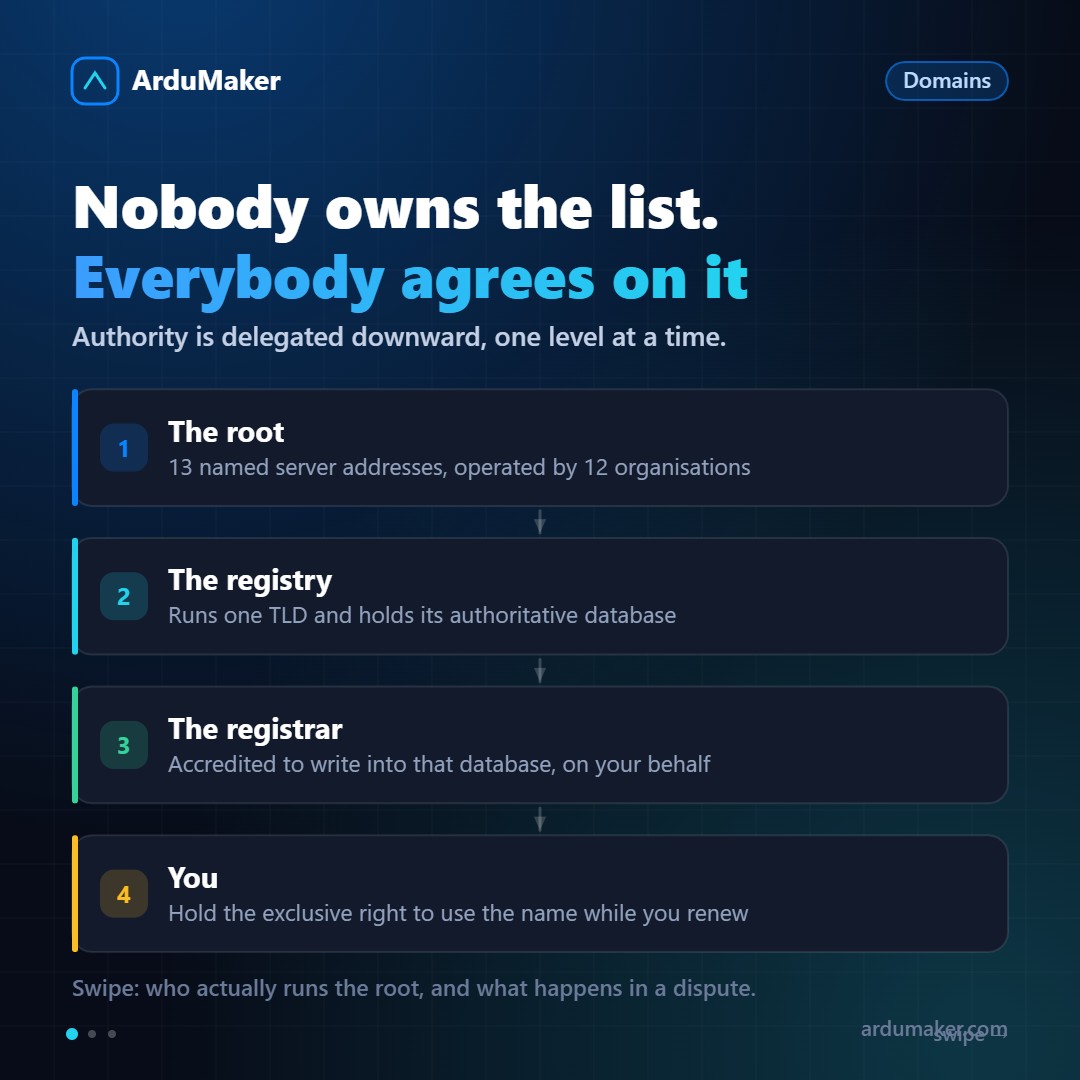
That zone is published by thirteen root server addresses, identified by letters, operated by twelve different organizations (universities, agencies, companies, technical bodies) distributed around the world. In reality, they are hundreds of physical machines, because each address is announced from many locations at once.
The coordination of what goes into that zone is done by ICANN, a nonprofit organization created in 1998. It is not a body of any single country: it is an entity with a multi-stakeholder model, where governments, companies, technicians, and civil society participate.
That governance is debated, and rightly so: there is constant tension over how much influence the different actors have. But it is what we have, and so far it has sustained a system on which much of the world depends.
Delegation Downward
From there downward, each level delegates to the next.
ICANN delegates each top-level domain to a registry: an organization responsible for that extension. Verisign for .com, and each country has its own for its country code.
The registry maintains the authorized database: which names exist under its extension and which nameservers they have.
Registrars are accredited companies to write to that database. When you buy a domain, the registrar records your ownership in the registry.
And you delegate to your own nameservers, which respond for everything under your name.
At no point in that chain is there someone who "knows" all the domains in the world. Each link only knows the next one.
What "being yours" means
Here is a clarification worth having clear from early on:
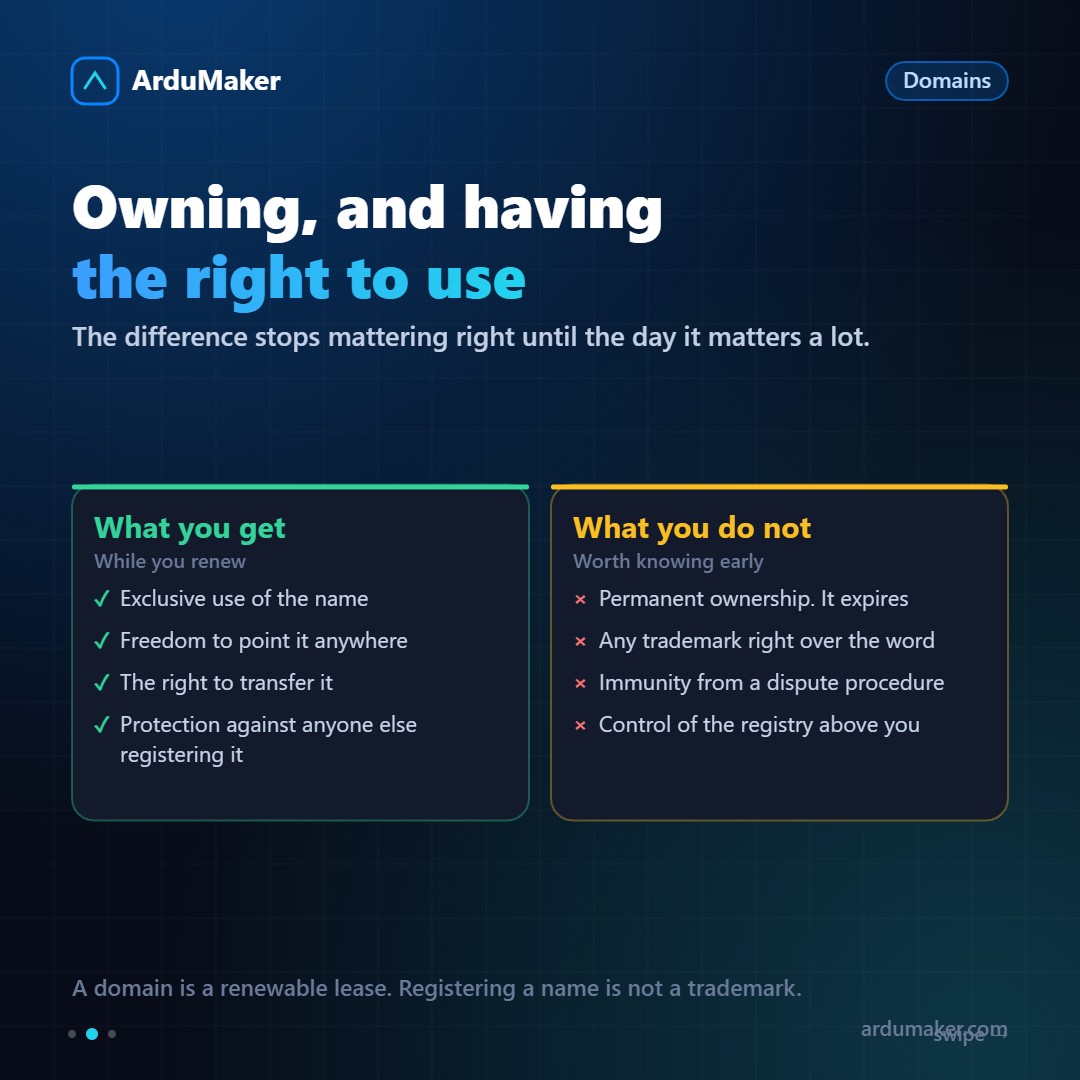
You do not own the name. You have the exclusive right to use it as long as you renew it.
It is a renewable rental. If you do not renew it, it enters a grace period, then a redemption period with a fee, and finally it becomes free for whoever wants it.
And registering a name does not give you any trademark rights over that word. They are separate legal systems.
When there is a dispute
If someone registers a domain that clearly corresponds to your trademark, there is an administrative procedure (the dispute resolution policy, UDRP) that allows you to claim it without going to trial.
You must demonstrate three things: that the domain is identical or confusingly similar to a trademark of yours, that the holder does not have legitimate rights over that name, and that they registered and use it in bad faith.
The procedure is relatively quick and much cheaper than a lawsuit, and its existence is also the reason why registering other people's brand domains to resell them is a bad business.
The four things that protect an important domain
All are free or nearly so, and all are commonly overlooked:
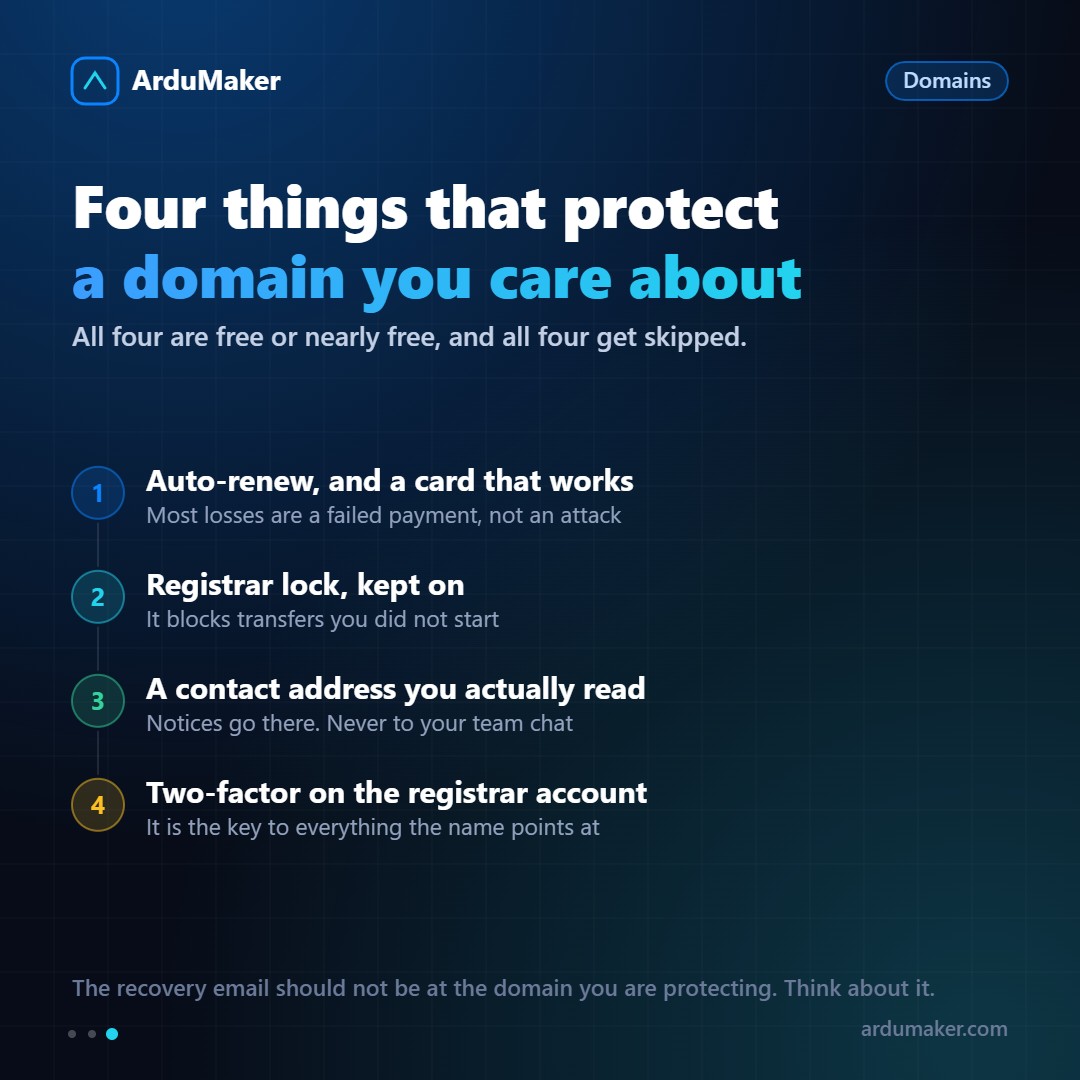
Automatic renewal and an active payment method. Most domains that are lost are lost due to an expired card, not an attack.
Registrar lock enabled. This prevents transfers you haven’t initiated yourself.
A contact address that someone actually reads. Notifications go there. And it’s wise that this address not be from the very domain you’re protecting: if the domain goes down, you also lose the email needed to recover it.
Two-factor authentication on the registrar account. That account is the key to everything the domain points to: the website, email, certificates. It’s worth protecting as such.