How the Internet Grew: From 4 Nodes to the Entire Planet
Published on 2026-09-12 by frfrand
Qué decisión de diseño permitió que escalara sin que nadie la coordinara, por qué TCP/IP le ganó a alternativas mejor financiadas, y qué se rompió por el camino.
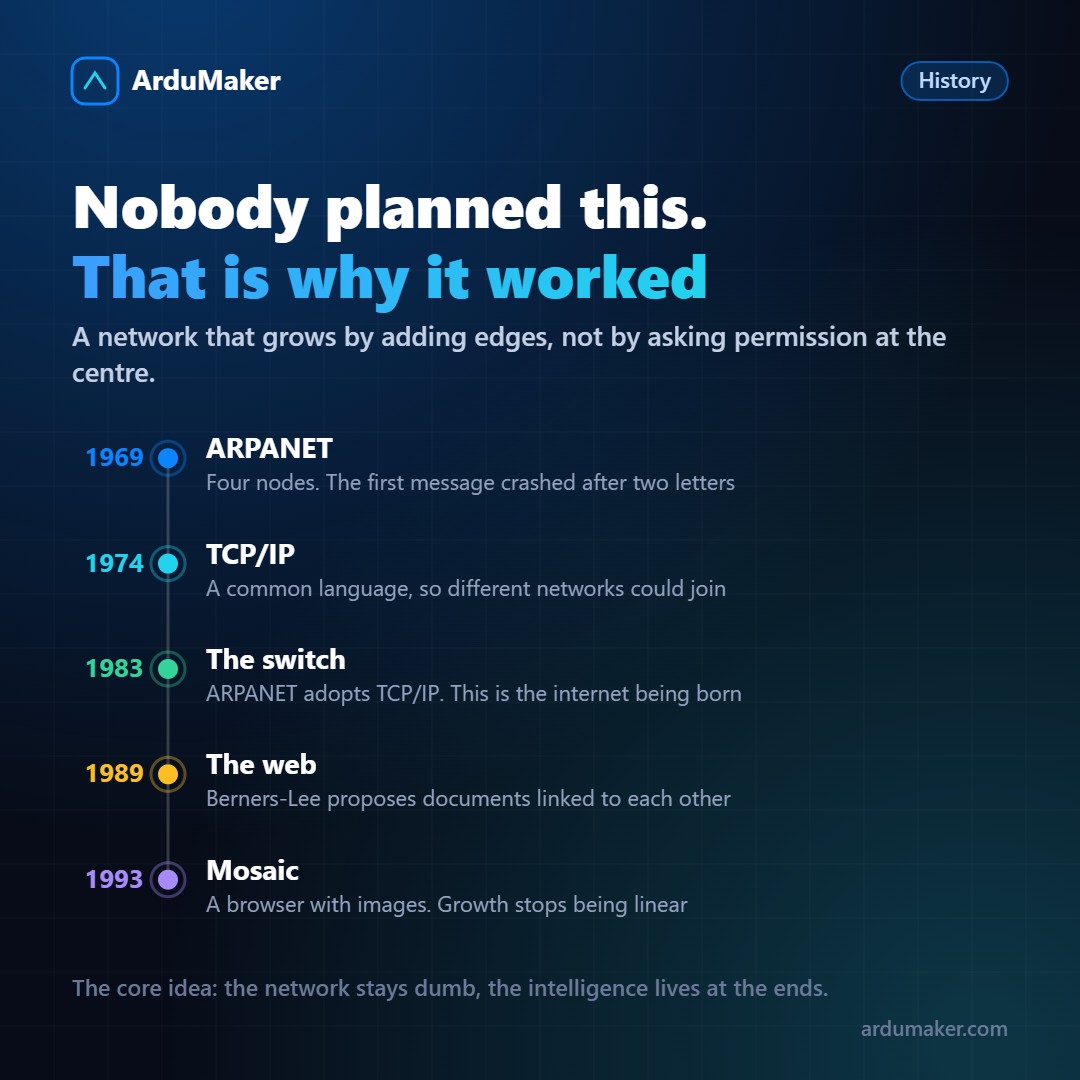
In 1969 ARPANET had four nodes. The first message they tried to send was the word "login", and the system crashed after the first two letters.
Fifty-something years later there are billions of connected devices. What's interesting isn't the growth: it's that nobody coordinated it.
The design decision that made it possible
Telecommunications networks of the time were intelligent at the center: the network knew who was talking to whom, reserved a circuit, and kept it. The ends were dumb, like a telephone.
Internet did the opposite: the network is dumb and the ends are intelligent.
Routers don't know what they're carrying. They don't reserve anything, don't guarantee delivery, don't verify order. They only look at the destination address and pass it to the next hop, "as best they can".
Everything else (reordering, detecting what's lost, retrying, controlling speed) is done by the computers at the ends, with TCP.
That choice has a huge consequence: to add something new you don't have to ask the network for permission. The web, email, video, videoconferencing, and everything that comes work without changing a single router. If intelligence were at the center, every new application would have required updating the world's infrastructure.
Why TCP/IP won
It wasn't the only candidate, and on paper it wasn't the best. There was a set of protocols backed by international organizations and major telecommunications companies, with a more complete and formal design.
TCP/IP won for three very unglamorous reasons:
It was implemented and it worked. While the alternative was being discussed in committees, TCP/IP was already moving packets.
It came with Unix. The Berkeley implementation was distributed with the operating system used by universities. Free and already installed.
The process was open. The specifications were published as RFCs, anyone could read them and implement them, and progress was made based on what worked in practice. The phrase that summarizes the culture of that community: rough consensus and running code.
The name, and why it was necessary
Remembering numerical addresses doesn't scale. In the early years there was a single text file with all the names and their addresses, which was distributed manually among the connected machines.
That stopped working quickly, and in 1983 DNS appeared: a hierarchical and distributed system where each domain is responsible for its own names.
It's the same old idea: instead of a central registry that everyone copies, a structure where each part manages its own.
The web, which is not the Internet
It's worth making the distinction because they are used as synonyms.
Internet is the network: the transport of packets. It existed twenty years ago and already carried email, file transfers, and forums.
The web is an application on top of Internet: documents with links between them, proposed by Tim Berners-Lee in 1989.
What made it explode was the browser with images, in 1993. From there, growth stopped being linear.
What broke along the way
Being honest about this is part of understanding it:
Addresses ran out. Four billion seemed infinite in 1981.
Security was not considered. Everything traveled in clear text, because the network was among people who knew each other. Everything that came after (HTTPS, SSH, certificates) are layers added on top of a foundation that assumed good faith.
It centralized in another way. Technically it remains decentralized, but in practice a huge portion of traffic passes through very few companies. The failure of a single provider can leave half the world without service, something the original design wanted to avoid.
None of these three things contradicts the above. They are the price of having scaled more than anyone imagined.