What is n8n and what problem does it solve
Published on 2026-09-12 by frfrand
Conectar servicios que no se hablan entre sí, sin escribir un script para cada combinación. Cómo funciona un flujo de nodos, cuándo conviene y cuándo es mejor código.
Every team accumulates glue tasks: when a form arrives, create a row in a spreadsheet, send a message to the chat, and open a ticket. When a payment is approved, update the CRM and send an email.
Each of those tasks is a small script. The problem isn't writing them: it's that afterwards there are fifteen, they live in different places, no one knows which ones are still running, and when one fails, no one finds out.
n8n is a tool to build those flows in a visible way and in a single place.
How it works
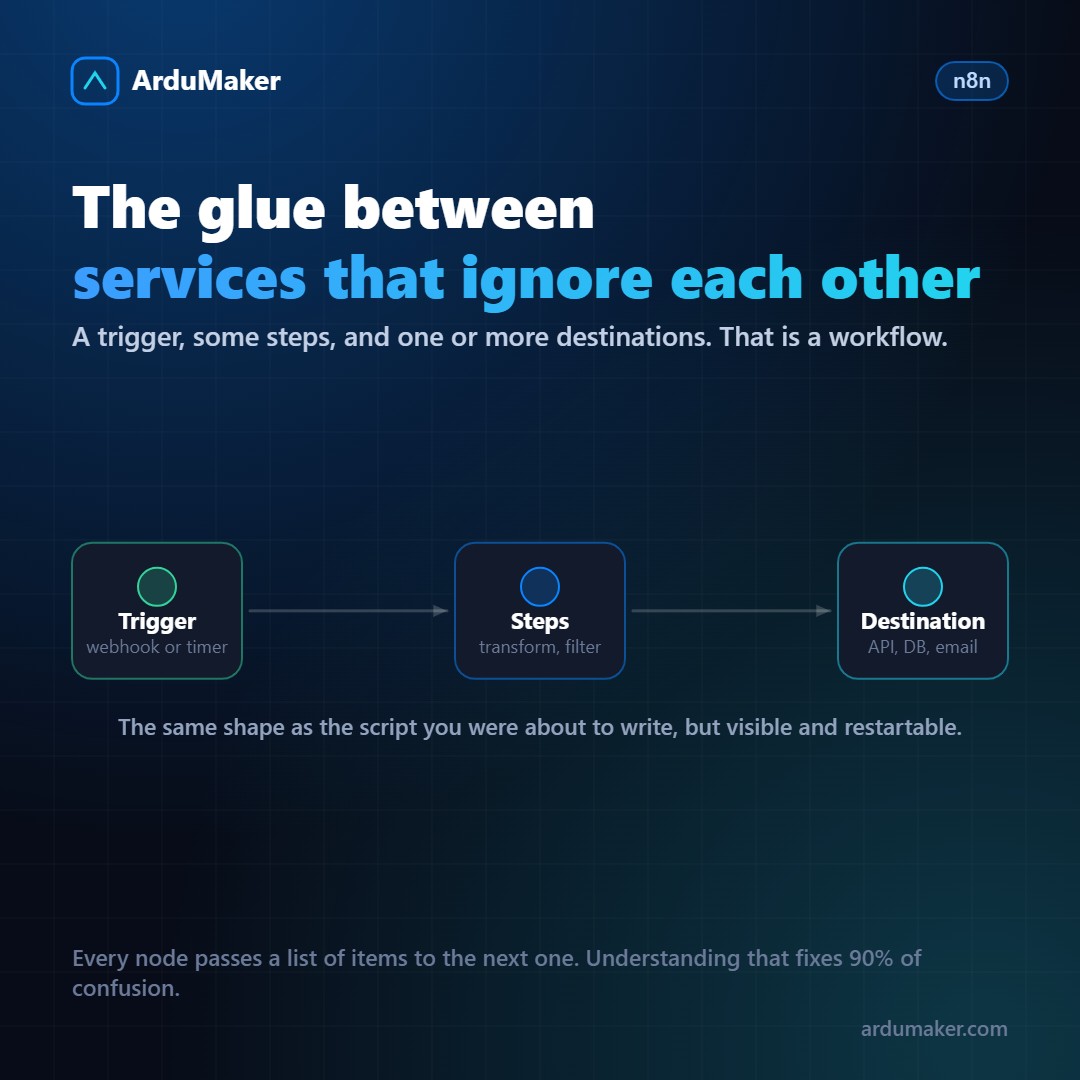
A flow starts with a trigger: a webhook, a schedule, a new message, a row added.
Then come nodes chained together. Each one does something: call an API, filter, transform data, decide where to go next, wait. There are ready-made nodes for hundreds of services, and there is always the generic HTTP node for any API that doesn't have its own.
The key data to understand it: between node and node a list of items travels. If a node returns five results, the next one executes five times, one for each one. That single concept solves most initial confusion.
Why it's not just for people who don't program
It's often pigeonholed as a "no-code" tool and that does it a disservice. What a technical team gains by using it is something else:
It's visible. A drawn flow is understood at a glance, even by someone who didn't write it. Fifteen scripts on a server, no.
Every execution is recorded. With the data that entered and exited each node. Debugging an integration that failed last Tuesday stops being archaeology.
It retries from where it failed. If step four of six errored because an API was down, you fix it and resume. With a script, you run everything again, with the risk of duplicating what was already done.
Credentials are in one place. Instead of scattered across configuration files of different scripts.
And for what nodes aren't enough, there is a code node where you write JavaScript or Python. You can mix them.
When it's worth it and when it's not
It's worth it for integrations between services, multi-step scheduled tasks, processes someone currently does manually, and quick automation prototypes.
It's not worth it as a replacement for your product's backend. If the logic is central to what you sell, it goes in your code: it's easier to test, version, and review.
It's also not worth it for very high volumes with critical latency. A visual flow has its overhead; to process millions of events per hour, code.
The detail that matters most: it's yours
n8n can be self-hosted. This means your data and credentials don't go through a third party, and the cost doesn't grow with the number of executions.
It's the biggest difference compared to cloud alternatives, and it's the reason why many people choose it: the day you automate something that touches customer data, where the engine lives stops being a detail.
In ArduMaker it's installed on your VPS from the panel, with its domain and its certificate. Executions run on your server, and consumption is that of your VPS, not a per-task bill.