Why n8n is free and paid at the same time
Published on 2026-09-12 by frfrand
No es open source en el sentido estricto: es "fair-code". Qué permite y qué no la licencia sustainable use, por qué se inventó esa categoría y qué significa en la práctica para tu empresa.
A question that always comes up: if n8n can be downloaded and installed for free, why does it also have paid plans? Where’s the catch?
There’s no catch, there’s a license worth understanding, because it explains a trend that repeats in several infrastructure tools.
It’s not exactly open source
n8n uses what its authors call fair-code, with a "sustainable use" license.
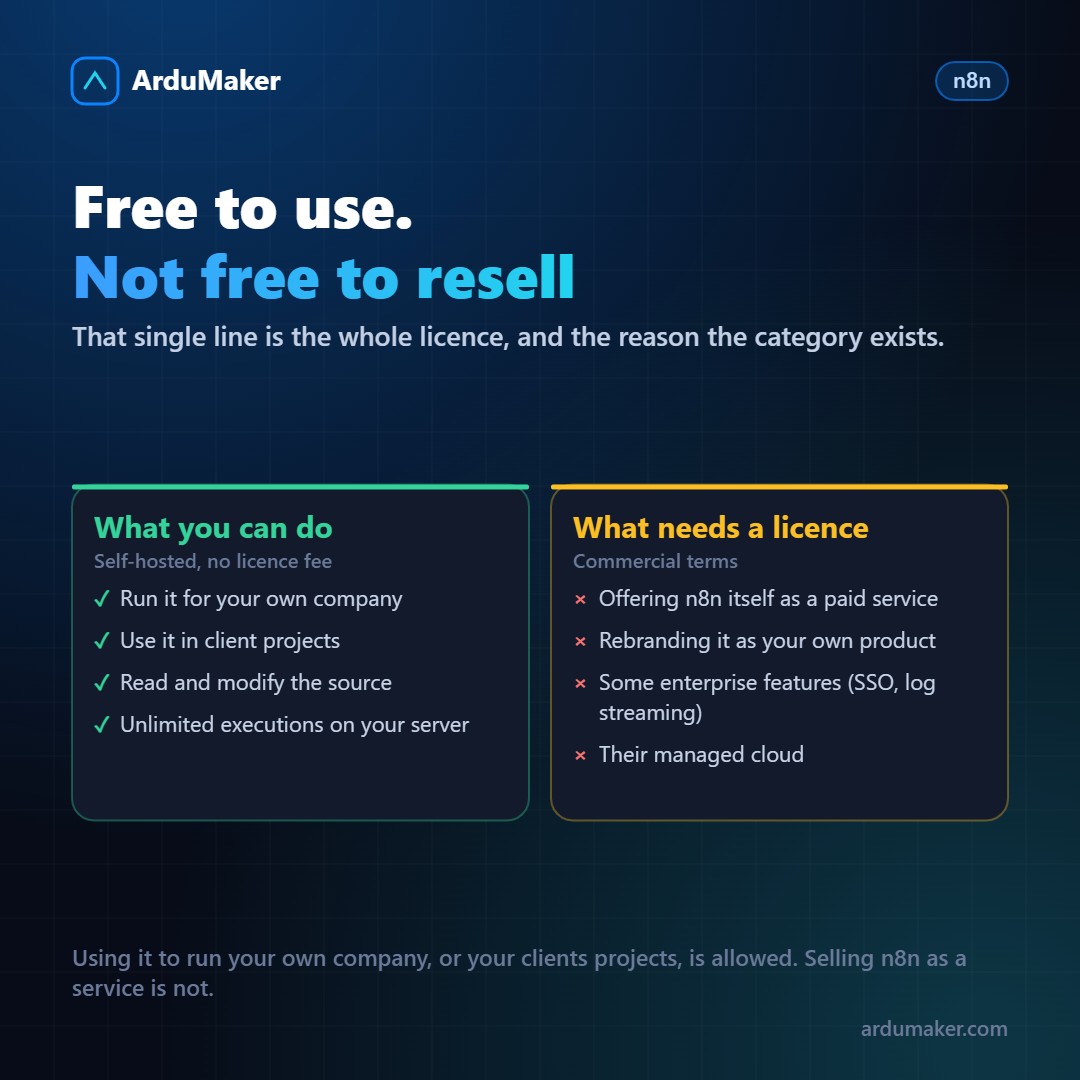
The code is public: it can be read, modified, and used. But it has a restriction that the strict definition of open source does not allow: you cannot sell n8n as a service.
You can use it as much as you want for your company, for your clients, in production, without paying anything. What you cannot do is set up a business that offers "managed n8n" and charge for it.
Why that category was invented
The problem it tries to solve is concrete and has repeated several times in the last decade.
A small company builds an infrastructure tool and releases it under a free license. It grows, becomes popular. Then a large cloud provider takes it, offers it as a managed service at scale, and keeps most of the revenue, while the developers continue maintaining the code.
Several well-known companies changed their license for exactly this reason. n8n’s license was created with this restriction from the beginning.
It's a legitimate debate: part of the community argues that restricting commercial use breaks the spirit of free software. The counterpoint is that the alternative model left several projects without funding.
What it means in practice
For the vast majority of cases, you can use it for free without any doubt:
- Automating processes in your company: allowed.
- Using it in client projects, as part of a solution: allowed.
- Modifying the code for your needs: allowed.
- Running millions of workflows on your server: allowed, and with no cost per execution.
You need to talk about a commercial license if your product is n8n under another name, or if you want certain features designed for large enterprises (single sign-on, environment version control, log export to external systems).
The two models, with different numbers
n8n Cloud: you pay per execution. Zero maintenance, get started in minutes. Cost scales with usage, and your data and credentials pass through their infrastructure.
Self-hosted: you pay for the server. Unlimited executions. Cost is fixed and predictable, and your data never leaves your machine. In return, maintenance and updates are your responsibility.
The break-even point comes quickly. A workflow running every five minutes equals nearly nine thousand executions per month: in the cloud, that’s already a paid plan, and on a small VPS it’s barely noticeable.
The deciding question, and it’s not the price
Beyond cost, there is something that weighs more: where your data passes.
An automation flow usually touches sensitive information: customer data, credentials for your systems, message content. Self-hosting it means none of that leaves your infrastructure.
If you work with third-party data or have compliance requirements, that is usually the deciding reason.
In ArduMaker, n8n is installed on your VPS from the panel, with domain and certificate resolved. It runs on your server, with your data, and without cost per execution.