How files were transferred before the Internet
Published on 2026-09-12 by frfrand
Disquetes en la mano, módems que ocupaban la línea del teléfono, BBS y UUCP. No es nostalgia: varias ideas de esa época siguen vivas en las herramientas que usás hoy.
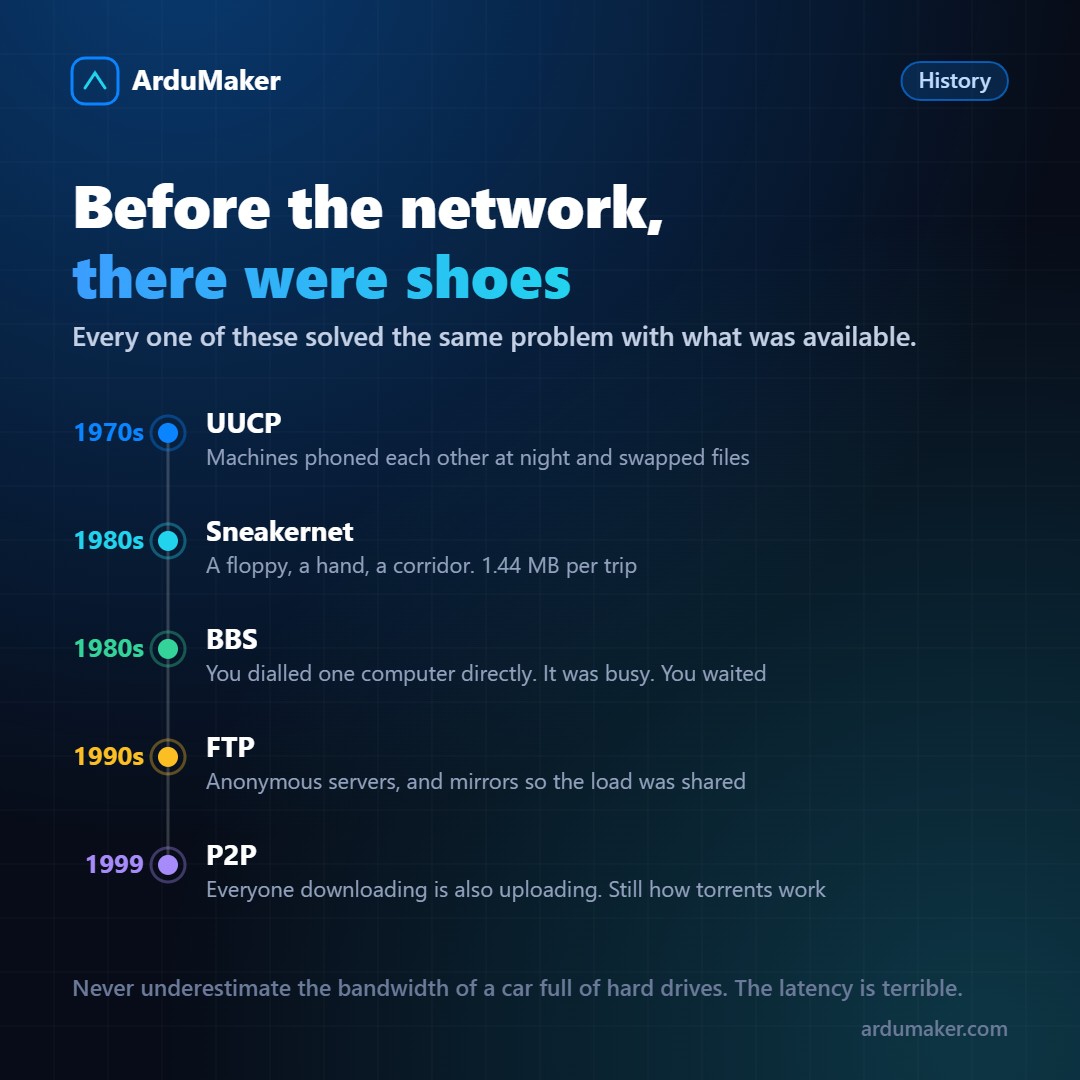
Today sharing a file is dragging it into a window. It is worth looking at how it was done before, not out of nostalgia: several of those ideas still work inside tools you use every day.
Sneakernet
The most reliable method for years: copy the file to a floppy disk and walk.
The name is a joke from that era (the sneaker network) and describes something real. A 1.44 MB floppy disk seems ridiculous today, but for a document or a program it was enough.
And there is an observation that remains true: never underestimate the bandwidth of a car full of disks. Physically moving 100 TB in a day comfortably surpasses almost any connection. What is terrible is latency: the first byte takes hours.
That is why large cloud providers still today offer to send you a physical device by mail to migrate enormous volumes. Industrialized Sneakernet.
UUCP: machines called each other at night
Before a permanent network existed, Unix computers connected in turns. UUCP (Unix to Unix Copy) made one machine call another by phone, usually in the early morning when the call was cheap, exchange files and email, and hang up.
Email traveled this way: jumping from machine to machine, sometimes for days. And since there was no central directory, you had to indicate the full path in the address, machine by machine.
From there remains an idea that is still alive: store and forward. If the destination is not available now, I save it and retry later. Every modern message queue system does exactly that.
The BBS
In the eighties and nineties, your modem called directly to one computer that someone had in their home, with one or two telephone lines. If it was busy, you waited and tried again.
Inside there were forums, messages, and files to download. The community was local, because long-distance calls were expensive.
Two details that today sound incredible:
- The modem occupied the phone line. If someone answered on another device in the house, the transfer was cut.
- Many BBS had quotas: you could download in proportion to what you uploaded. A reciprocity economy that reappeared decades later in peer-to-peer networks.
FTP and mirrors
With the academic Internet already working, FTP and anonymous servers appeared: public places to download software.
As a popular server became saturated, mirrors emerged: copies of the same content at universities in different countries. You chose the closest one.
That idea is, in essence, what a content delivery network does today: bring the file closer to whoever requests it. Automation changed, not the concept.
The leap to peers
In the late nineties, the idea that broke the model appeared: if many people want the same file, let them pass it among themselves.
The mature version is BitTorrent, and its contribution is elegant: the file is split into pieces with their hash, and each person who downloads also uploads the pieces they already have. The more people want something, the faster it is distributed, the opposite of the client-server model.
That is still the most efficient way to distribute large files to many people, and it is used for perfectly legal things: Linux distributions, scientific datasets, game updates.
What remained
- Store and forward from UUCP → message queues.
- Mirrors from FTP → content delivery networks.
- Hash verification from BBS and torrents → how you verify today that a download is intact.
- Sneakernet → cloud providers' mail migration service.
None of those ideas were obvious when they were invented. All of them solved the same problem with what was at hand.