What virtualization is used for in real life
Published on 2026-09-12 by frfrand
Más allá de "aprovechar el hardware": aislar clientes, poder destruir sin miedo, reproducir un entorno, mover máquinas sin apagarlas y recuperarse rápido. Cinco usos concretos.
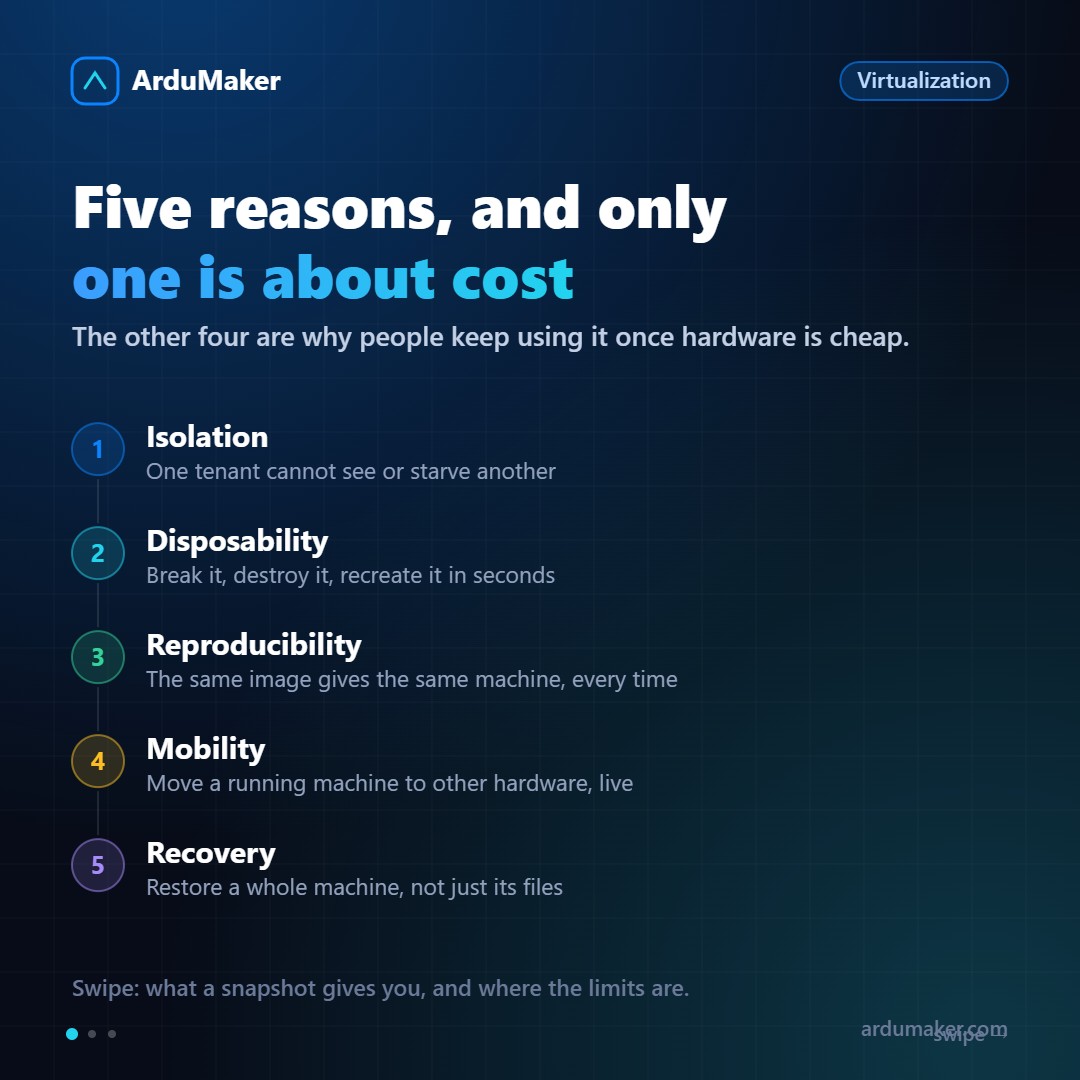
"To better leverage the hardware" is the textbook answer, and it's the least interesting one. Today hardware is relatively cheap; virtualization is still used for things that have nothing to do with cost.
1. Isolation between things that shouldn't be mixed
Two different clients, or two applications that don't trust each other, shouldn't share an operating system.
On a shared server, a permissions error, a privilege escalation vulnerability, or simply a process that consumes all memory affects everyone. On separate virtual machines, each one has its own kernel, its own users, and its own resource quota.
That structural isolation is much harder to break by accident than one based on configuring permissions well. It's the reason why at ArduMaker each client lives in their own VPS and not in a folder on a shared server.
2. Being able to break things without fear
This use changes how you work.
If you need to test a major update, a migration, or a configuration you don't fully understand, you can create a machine, break it completely, and destroy it. In thirty seconds you have another clean one.
With dedicated hardware, every test is an event: you have to reinstall, you have to coordinate. With virtual machines, testing is cheap, and when testing is cheap, people test. That improves the quality of decisions more than any process.
3. Reproducing an exact environment
A virtual machine image is a file. From the same file you get the same machine, with the same versions of everything.
That solves the most frustrating kind of problem there is: "it works on my machine." And it allows having a test environment that truly resembles production, instead of one that only resembles it from memory.
4. Moving machines without shutting them down
A virtual machine can be migrated to another physical server while it is running, with an interruption of milliseconds. Memory is copied in stages and at the last instant control is transferred.
That is what allows hardware maintenance without downtime windows. Without virtualization, changing a server means shutting down everything running on top of it.
5. Recovering quickly
Restoring a physical server from scratch means reinstalling the system, configuring everything, and recovering the data. Hours, if everything goes well and the documentation is up to date.
Restoring a virtual machine means booting an image. The entire machine comes back as it was: system, configuration, and data.
About snapshots, honestly
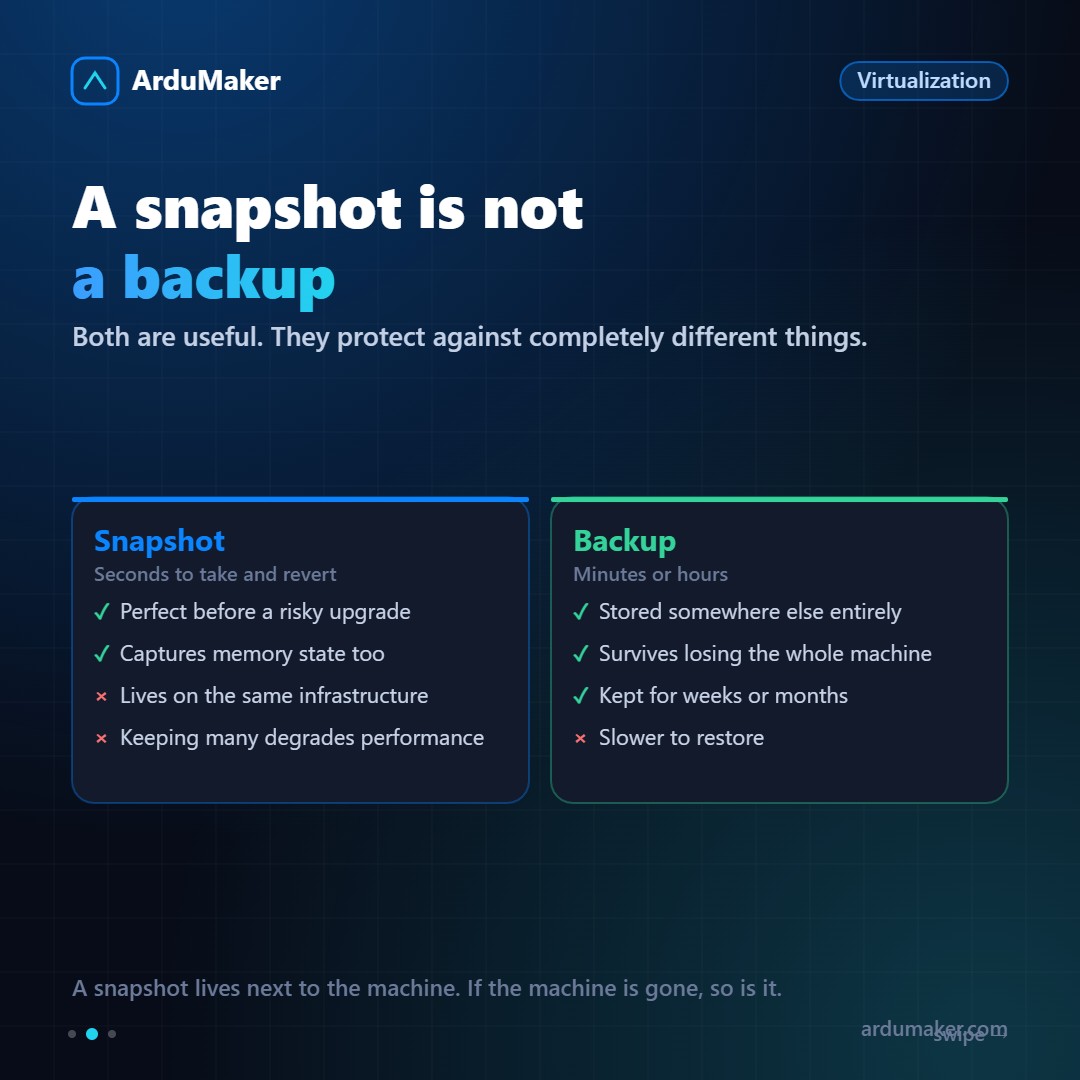
A snapshot saves the state of the machine at a moment, and allows returning to it in seconds. It is fantastic for "I'm going to do something risky in the next twenty minutes."
Two limits worth being clear about:
- It lives on the same infrastructure as the machine. If the host is lost, both are lost. A snapshot does not replace a backup stored elsewhere.
- Accumulating too many degrades performance, because every read has to go through the layers of accumulated changes.
Rule of thumb: take a snapshot before a risky change, and delete it once you confirm everything went well. The backup is something else and is kept separate.
What virtualization does not solve
It is worth saying because it creates a false sense of security.
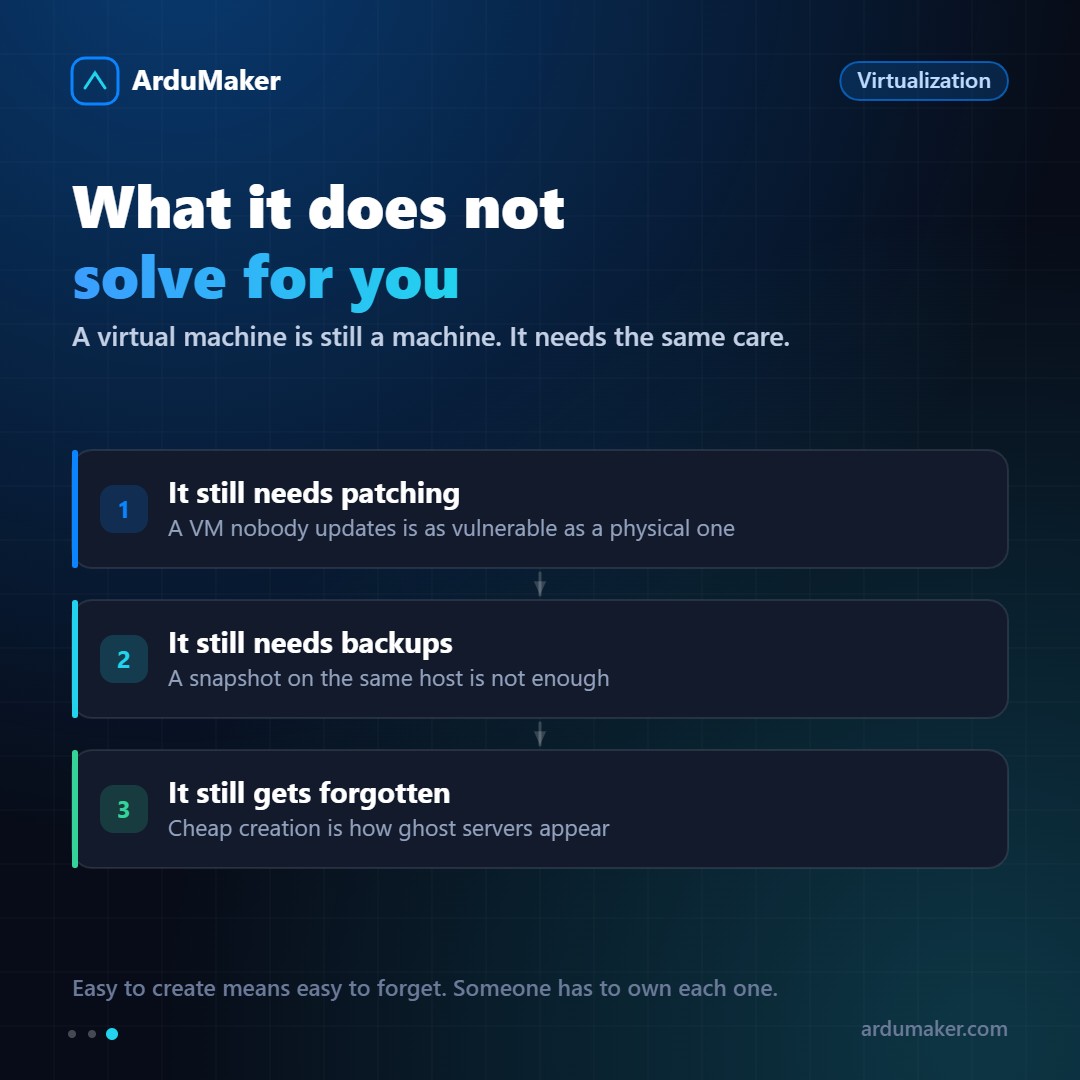
A virtual machine is still a machine: it needs to be updated, backed up, and monitored. Isolation protects the other machines from this one, not this one from itself.
And it brings a new problem: since creating one is so easy, ghost servers appear. Machines someone created for a test, that keep running, that no one updates and no one remembers. Each one is an open door.
That is why it is a good idea for every machine to have an owner and a reason noted from day one.